
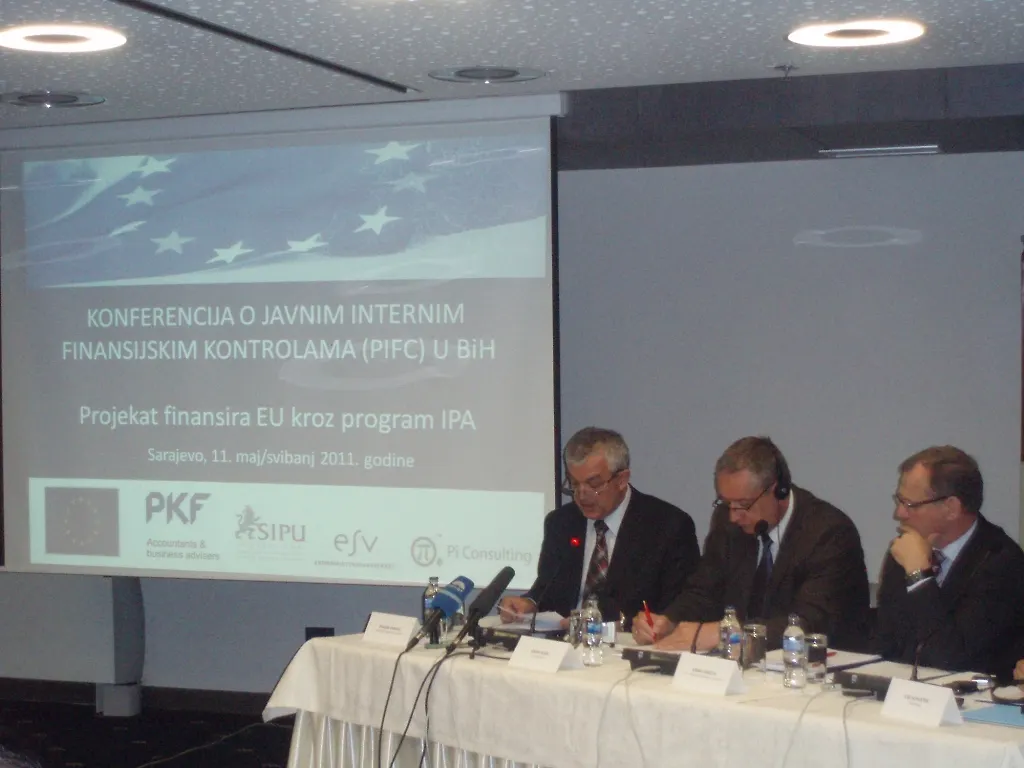
Deputy Chairman of the Council of Ministers of Bosnia and Herzegovina and Minister of Finance and Treasury Dragan Vrakić opened a Conference on Internal Financial Control, which started in Sarajevo today, organised by the Ministry of Finance and Treasury of B-H and supported by the Technical Assistance Project titled “Support to Introduction of Internal Pubic Financial Control”, sponsored by the European Union. The internal public financial control includes audit and financial management and control, and it represents an important framework for the implementation of the EU acquis communautaire, which implies an establishment of institutions capable of public funds spending control, thereby supporting the public administration reform, as one of the benchmarks in the B-H’s EU integration process.
The aim of the Conference is awareness rising with senior mangers concerning the internal public financial control, especially in view of the legislation adopted and importance of public internal financial control for the EU integration process of B-H.
Opening the Conference, Minister Vrankić said that within the reforms relevant for the fulfilment of obligations B-H assumed on signing the Stabilisation and Association Agreement, in part “Cooperation in Audit and Financial Control”, the Council of Ministers adopted a document titled “B-H Institutions Public Internal Financial Control Implementation Strategy”- PIFC- with similar documents being adopted by Entity Governments, as well.
-
The implementation of PIFC Strategy, as he stressed, implies a setting-up organisation units within the Ministry of Finance and Treasury, such as the Central Harmonisation Unit and independent Internal Audit Division, which, each for itself, represent leverage for the introduction of the PIFC concept in B-H Institutions.
He added that the Ministry of Finance and Treasury has already completed these activities and that within its competences it strongly supports the operability of a body responsible for coordination of relevant activities with Entity level bodies.
-
Head of the Section for Economic Development Operations, Natural Resources and Infrastructure of the EU Delegation in B-H Johann Hesse said that the internal financial control in B-H is one of the elements EU wants to see well functioning in order to move further and transfer fund management.
-
Head of PIFC Team Robert Konning underlines that this issue is a key issue for the Ministry of Finance and Treasury and that it represents a basis for good management.
According to Head of Central Harmonisation Unit within the Ministry of Finance and Treasury Ranko Šakota, the process of establishment of PIFC structures may take seven years. (Fena)